Careers to Consider: Architecture / Construction Technology
This article is part of a series spotlighting HFC academic and workforce programs leading to great careers. To view all HFC programs, visit this link.
Architecture/Construction Technology
The HFC Architecture and Construction Technology (ACT) program teaches computer-aided design (CAD) and building construction methods and materials, which includes both residential and commercial buildings.
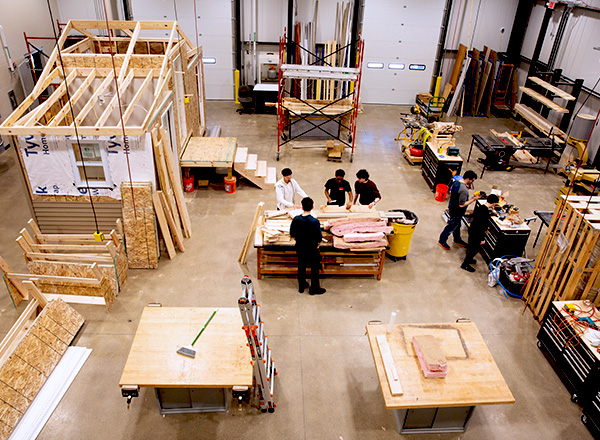
You won't just sit in classrooms. You will engage in real-world projects in the labs and in the community. The HFC curriculum is unique among other college programs in that it is project-based, allowing you to gain an understanding of building construction through practical, hands-on activities. You will explore all facets of residential and commercial design and construction while working with state-of-the-art, industry-standard software, construction materials, and techniques.
“Our program is designed to provide you with a foundation in the principles and practice of building construction,” said HFC Building Sciences Chair Chad Richert. “By the time you finish, you will have an excellent platform to pursue careers in architecture, construction management, civil engineering, and much more.”
What you will learn
Laboratory classes provide experience in:
- Residential and commercial construction materials
- CAD and technical development
- Cost estimating
- Construction methods
- Client presentation and public speaking techniques
- Project management
- Residential construction practices and use of surveying equipment
The program also covers the principles and necessary skills of the architectural profession supported by an understanding of building construction through hands-on activities that are designed to provide you with a practical skills-based education.
“One of the things I really love about HFC is we are very hands-on,” said Richert. “We have a construction lab. We teach drawing and design. We talk about how buildings go together, how the trades work together, then they’re pouring concrete and they’re framing roofs and trusses, so the connection and the discipline are so important.”
Richert, who has been teaching at HFC since 2000, has seamlessly applied his real-world experiences into the classroom. Prior to joining HFC, he worked at TMP Architecture, Inc. in Bloomfield Hills for 10 years, where he specialized in sports and recreation design. A high point of his career was contributing to the construction of the University of Alabama Student Recreation Center in Tuscaloosa, AL.
Richert earned his bachelor’s degree in environmental design from the University of Colorado at Boulder and his master’s degree in architecture from the University of Michigan in Ann Arbor. He is a certified Project Lead the Way instructor and a licensed architect through the National Council of Architectural Registration Boards.
Program features and benefits
ACT students have collaborated with other departments and programs on campus, and they’ve also collaborated on real-world projects with the City of Dearborn and RE/MAX, LLC.
Alongside students in HFC’s Interior Design program, ACT students designed and planned the restoration of a Historic Henry Ford Home in the Ford Historic Homes District. This home was built in 1919 on Nona Street by automotive tycoon Henry Ford for factory workers.
The City of Dearborn planned to raze the house, but the Ford Historic Homes District wanted to preserve it. In the end, the late Dearborn Mayor John B. O’Reilly, Jr. came up with the idea to work with HFC students on restoring the house as a training exercise. Twenty-five HFC students worked on this project.
“This was a fantastic opportunity for the students,” said Richert. “And it was beneficial for us to have them actively working on a design project, especially one with such historic significance. Students in the ACT program really enjoyed working with fellow HFC students from a different program.”
Another high point for the ACT program, and one of Richert’s favorite projects, is the Tiny Home. This was a collaboration with RE/MAX, which auctioned it off for $47,000 to benefit the Children’s Miracle Network Hospitals.
“The Tiny Home project has been a rewarding hands-on experience. It’s taught me a lot,” said HFC alumnus Darren Reed. In 2018, more than a dozen students from HFC’s ACT, Interior Design, and Energy Technology programs teamed up to design and build a single-story Tiny Home with a loft that has a footprint of just 202 square feet. Richert noted the level of complexity had never been attempted before by the ACT program.
“The ACT program beat professional contractors when bidding for this project,” he said. “That speaks volumes about our program!”
Career opportunities
There are many career opportunities in the ACT field, including:
- Appraiser
- Architectural CAD technician
- Architectural illustrator
- Building and construction technician
- Building code inspector
- Building materials sales representative
- Builder
- Carpenter
- Construction estimator
- Civil engineer
- Civil engineering technician
- Facilities management technician
- Materials testing lab technician
- Structural steel detailer
Transfer options
After you complete the HFC ACT program, you can transfer to a 4-year educational institution to complete your final two years of your bachelor's program. HFC has articulation agreements with the following universities to make transferring easier:
Richert is working on articulation agreements with several more universities.
Course schedule
Review the recommended sequence of classes and speak with an academic advisor before registering. We always recommend you talk to your advisor to make sure you select the right courses, stay on track toward graduation, and prepare for transfer or employment.
The ACT Advisor is Rachel VanZutphen. To make an appointment with VanZutphen, contact her at 313-845-9873 or rvanzutphen@hfcc.edu.
For questions or more information about the ACT program, contact Richert at 313-317-1515 or crichert@hfcc.edu.