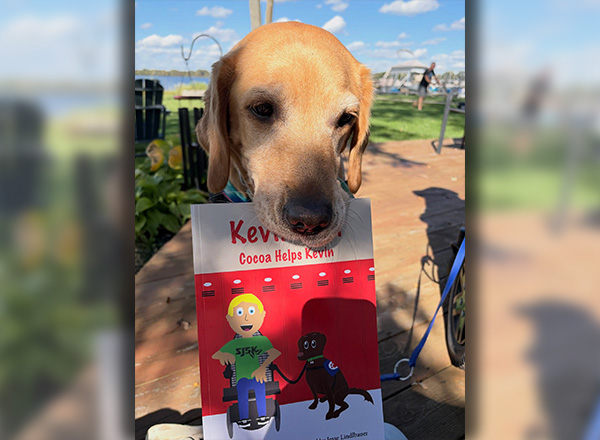
Authors Flanagan and Lindlbauer return to HFC to share info on new children’s book
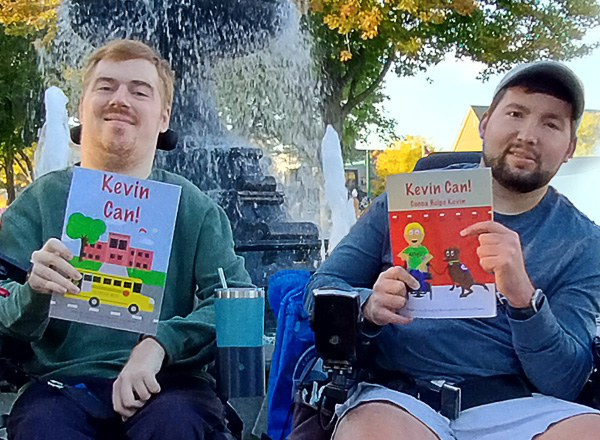
Authors Ian Flanagan and Jesse Lindlbauer will make their second appearance at HFC, speaking about their newly-released children’s book, Kevin Can! Cocoa Helps Kevin on Thursday, October 29, from 10:00 a.m. to noon in the Rosenau Rooms on the first floor of the Andrew A. Mazzara Administrative Services & Conference Center (ASCC) (Building L on the main campus).
They will be joined by Lindlbauer's service dog, Trooper. Two fifth-grade classes from William Ford Elementary School will also be in attendance. This event is sponsored by the HFC Pre-Education program. HFC Pre-Education Director Dr. Carolyn Casale invited the two Canton-based authors to the College.
"I am impressed with the dedication and attention to detail that Jesse and Ian put into their books. This is their second book, and I expect there will be others," said Casale. "I'm confident Jesse and Ian will also inspire young people to write their own stories."
Book teaches proper etiquette around service dogs
Flanagan and Lindlbauer are wheelchair users. They created Kevin Can! about the titular character, also a wheelchair user, because children would ask them about what it was like being in a wheelchair. Parents would quickly pull their children away and tell them that their questions weren't polite. The authors wanted to address children's curiosity as a learning tool about being in a wheelchair and how disabilities should be addressed in the classroom and in public. Written in a Q&A format, the book is a resource for having important discussions and to break the stigma about people in wheelchairs.
"Kevin is born out of our interactions with kids who are curious about wheelchairs," explained Flanagan. "Neither of us is Kevin, but both of us are Kevin. He is an amalgam of our experiences."
Cocoa is a sequel to Kevin Can! In it, Kevin can do more than before because of Cocoa, his service dog. In show-and-tell, Kevin introduces his classmates to Cocoa, showing them all the amazing ways she helps him be more independent. Cocoa accompanies him to the store, picks up objects he drops, opens doors for him, and more. Kevin also teaches readers how to recognize a service dog and learn the proper way to behave so the dogs aren't distracted from doing their job.
"Students naturally want to pet Cocoa and play with her and give her treats, but Kevin explains that they can't do that when she’s wearing her service dog vest because she's on duty. It's okay to pet her and play with if she has no vest on, but if the vest is on, she's working. If they distract her, Cocoa can't help Kevin. Cocoa doesn't just help him with everyday tasks, she's also trained to detect when he's about to faint or have a seizure. The training is rigorous for service dogs. Distracting them disrupts their training. People who depend on them for their independence and even life-and-death situations don't want that disruption," explained Flanagan.
Cocoa is based on Trooper, whom Lindlbauer acquired from Paws for a Cause.
"She inspired the book," said Lindlbauer. "Trooper opens doors for me and picks things up like Cocoa does for Kevin. I can relate to Kevin a lot."
Added Casale: "As a dog owner, I'm astonished by the ways dogs work to support people. This is a wonderful book that will help children learn more about service animals."
Rhyming format attracts a wider range of audiences
Both Flanagan and Lindlbauer wanted to create a story about a service dog that was grounded and realistic.
"We wanted kids to be able to relate to it and be entertained by it," said Flanagan. "One of the biggest gripes I have about disabled literature is it can be unrealistic, almost superhero-esque, which gives the wrong impression. We wanted to come up with a realistic story people would enjoy, which was a unique challenge. It was tempting to go the fantastical route, but young readers are curious enough that it doesn't need to be fantastical."
The difference between the two books is this one is written in rhyme instead of a Q&A format. Flanagan started Cocoa by writing a poem, then started working it into prose.
"The first book was geared toward presenting it in a classroom. The Q&A format was a teaching tool, but it wasn't strong enough for individual reading with this one," said Flanagan. "Rhyming has repeat value; children can read it multiple times – not just in class but on their own or with their parents."
Added Lindlbauer: "The rhyming gives us a wider range of audiences because people like to hear rhymes. Maybe it'll stick in their heads and they'll want to hear it again."
Flanagan and Lindlbauer are astonished at how Kevin Can! has been received by the general public. They have given presentations at schools, community centers, bookstores, and even appeared on CBS News Detroit.
"I'm stunned about how much the community rallied around the first book and how warmly it was received by local schools. Parents are happy that there's a resource like this to talk to their children about a stigmatized topic; it's been very validating," said Flanagan. "Carolyn has been instrumental in this. It's a real honor. I love going to HFC and I'm glad to be invited back."
The event is free and open to the public. For questions and more information, contact Casale at ccasale@hfcc.edu.
Related content: "Kevin Can!" authors on Channel 62 Detroit