First-gen alumnus chooses to defend people who have no one else
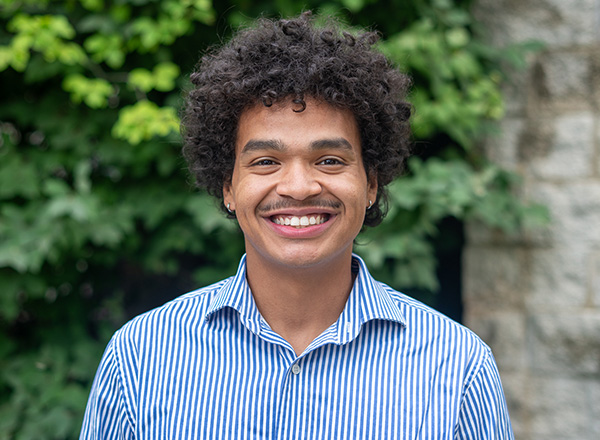
Alumnus Brad Gonzalez is a first-generation college student. He is also the first person in his family to become an attorney. And he has chosen to focus his law career on helping people who have no one else advocating for them.
After completing his undergraduate studies, Gonzalez worked at the Southwest Detroit Immigrant and Refugee Center as an IT manager. He met SWIRC founder Kevin Piecuch, an attorney dedicated to helping his community. Piecuch became his mentor and inspired Gonzalez to go to law school. He enrolled at the University of Michigan in Ann Arbor.
"I saw how much Kevin meant to the people," said Gonzalez. "His expertise in immigration law gave him the ability to change people’s lives in ways I’d never seen before. I was awestruck by that. That’s something I wanted to bring to the community. It is the reason I went into law."
HFC made law school possible
The eldest of four sons, Gonzalez is a native Detroiter. He is fluent in Spanish and is a graduate of Lincoln Park High School. After high school, he enrolled at HFC and earned his associate degree in business management in 2019.
"There’s a lot to say about Dearborn," explained Gonzalez. "The multicultural environment in Dearborn and at HFC was invaluable for me. There’s a real cultural exchange at HFC. Learning from others in that environment was great. You get every flavor of Southeast Michigan at the College, which is a very useful primer for wherever you will work."
Gonzalez named HFC instructors Anthony Perry, Elaine Saneske, Rachelle Loomus, Corinne Asher, Maria Sepulveda, Nassrine Karaali, and Gordie Wilson as very influential. During his time at the College, Gonzalez was active in the Michigan Democracy Institute Consortium.
"Brad was a very hard-working and engaged student in my class. When he was working hard in school and outside of school. He participated in our first Community Engagement Seminar and was always looking for new opportunities to grow, learn, and connect. I remember connecting with him several times during COVID, as was still seeking new opportunities when others were content staying put. He has a drive to be successful. This is another big step on his journey forward," said Perry, who teaches political science.
Gonzalez admitted that he had difficulty with writing during high school. That changed when he came to HFC. Learning the basic building blocks of writing and grammar at the College paved the way for him to draft clear, concise legal briefs.
"I’m often asked, 'How did you get into one of the Top 10 law schools in nation?’” he says. “It was because of my education HFC, which provided the building blocks I needed to succeed," said Gonzalez. "I went to HFC and started with basic courses. The academics at HFC are rigorous, but I felt a lot less pressure. It was an environment where I could focus on my learning. The small classes worked for me. I could talk to my professors with ease. Coming out of high school, I didn’t have the greatest study habits, but I knew I wanted to go to law school, and HFC provided the path to do it."
A powerful experience
Transferring to Wayne State University, which he attended on a Gold Merit Award Scholarship, Gonzalez earned his bachelor’s degree in business administration with a major in information systems. In 2026, he earned both his juris doctor (law degree) and his master’s degree in social work from the University of Michigan.
During his time in law school, Gonzalez completed two internships:
- The Public Defender Service for the District of Columbia
- The Amica Center for Immigrant Rights in Washington, D.C.
Working for Amica was a powerful experience. There, he assisted with defense for people who were detained by Immigration and Customs Enforcement (ICE).
"I was at ICE detention centers helping clients by doing translation and writing legal briefs. I talked to people who got picked up by ICE and are waiting in detention for immigration proceedings," he recalled. "Those two internships really showed me that without competent counsel, the odds are really stacked against the average person. I got to see what robust criminal defense looks like. Many people living in poverty don’t get that. In Washington, D.C., it’s different. You might actually have a fighting chance of winning your case."
Helping people, his way
Recently, Gonzalez began his job as a staff attorney for the Neighborhood Defender Service in Detroit, a public defense nonprofit organization that takes on 50% of the felonies committed in Wayne County.
"I’m really interested in helping people," he said. "That was my primary motive for going to law school and getting my MSW. Growing up, my mom worked at Gleaners Community Food Bank in Detroit. She modeled what it looked like to help people. I volunteered at Gleaners beginning when I was five. I’d box food with her on Saturday mornings. I realized that helping people is important, and was something I wanted to recreate in my own career -- but in my own way."
Gonzalez wants to focus his career on indigent criminal defense.
"I’m doing this for a number of reasons. I’ve seen firsthand in my personal life and in my professional experience how unfair the criminal justice system can be to people. I knew in law school that I wanted to work with people experiencing poverty. I was stuck between immigration and criminal defense. I tried both and found that being a public defender was right for me," he said.
His career goal is to become a senior attorney, working felony cases in his community and helping those in need.
"Society often throws away those who make mistakes," said Gonzalez. "This is what I like about criminal defense. As a public defender, you have the opportunity to give people a second chance. You show them at least one person is on their side, which is powerful. Sometimes, you’re the only one in their corner. Their friends and family may not show up, and they have nobody else except you. It’s quite an honor to be that one person."