HFC joins Open Door, providing basic needs support for students
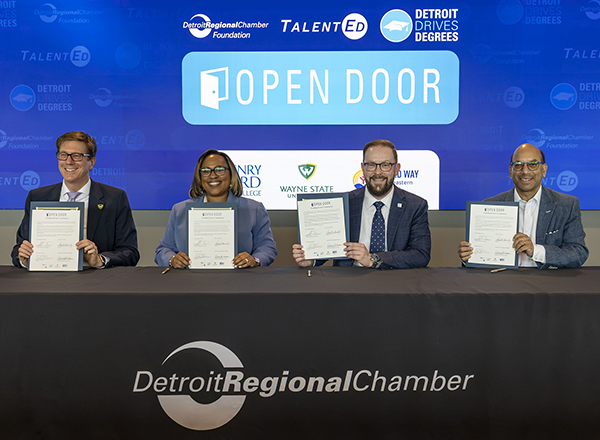
H enry Ford College President David M. Knezek, Jr. spoke during a July 30 launch event in Detroit to announce the College’s commitment to Open Door, a new on-campus student support program to address basic needs beyond academics. The program is convened by Detroit Drives Degrees, an education and talent program of the Detroit Regional Chamber, in partnership with HFC, Wayne State University, and the United Way for Southeastern Michigan.
Through Open Door, a dedicated United Way staff member will work on the HFC campus to help students navigate housing instability, financial emergencies, child care needs, transportation barriers, and food insecurity. Students tell their story one time to the dedicated United Way navigator. From there, a warm referral process connects them to campus and community resources, and the navigator stays connected with them until solutions are in place.
The program focuses on students participating in Detroit Promise, Detroit Reconnect, and Michigan Reconnect programs at Henry Ford College and Wayne State University. But no student seeking support will be turned away.
Why Open Door matters at HFC
More than 600 Detroit Promise students attend Henry Ford College, and roughly two of every three Detroit Promise students attending a community college choose HFC. Henry Ford College has been a Detroit Promise partner since the program's beginning. HFC also serves a large population of Michigan Reconnect students, adults returning to school at all ages from 21 to 35, 45 and beyond — many of them working full time while raising children or caring for parents. In summer 2025, HFC expanded its partnership with the Chamber through the state's Reconnect Community Action Grant to strengthen navigation and support for adult learners across the region.
“When you hear that Open Door focuses on Detroit Promise, Detroit Reconnect, and Michigan Reconnect students, you should know that these students are at the core of the communities we proudly serve,” said HFC President David M. Knezek, Jr. “Here is what these students have taught us: Tuition-free does not mean cost-free. A scholarship covers education costs – and that’s incredibly important. But it cannot cover a car repair. It can’t cover a month of child care, a security deposit, or the lost wages when a student’s hours get cut at work. And what we see, again and again, is a student who is doing fine in their classes, and then something happens that has nothing to do with school, their education gets put on pause, and the momentum they were building is lost. They didn't give up on their goals; life got in the way.”
Knezek, who became HFC's seventh president on July 1, said the College's entire strategic plan is built on student success in and beyond the classroom, and that Open Door strengthens the part of that work a college cannot do alone.
“We have a food pantry and counselors and outreach staff who work incredibly hard for our students. But our students need and deserve more – supports that don't always fit neatly into singular program or support. Simply providing them a list of external resources and referrals isn't enough,” he said.
Other speakers, including Detroit Regional Chamber President and CEO Sandy Baruah, Wayne State University President Richard A. Bierschbach, United Way for Southeastern Michigan President and CEO Darienne Hudson, and Detroit Drives Degrees Senior Director Meghan Schmidbauer spoke in support of the initiative at the launch event. All four Presidents signed on to the agreement.
A commitment beyond the signature
Henry Ford College is committing to put action behind its participation. The College will provide Open Door with dedicated space on campus, promote the program to students, connect it directly to HFC coaches and advisors, and measure its results honestly, including on the days the data shows the College something it needs to learn.
This basic-needs support model reflects national findings and state policy direction. Research from the Hope Center's most recent national student basic needs survey found that 41% of college students experience food insecurity and 48% experience housing insecurity, and that nearly eight in 10 students who dropped out or considered dropping out pointed to basic needs or financial pressures as a factor. Michigan's Student Basic Needs Task Force recommended placing navigators on campuses to connect students to campus and community resources. Open Door puts that recommendation into practice.
Partners are critical to success
Henry Ford College is grateful to the Detroit Regional Chamber and the Detroit Drives Degrees team for convening and leading this work; to United Way for Southeastern Michigan for bringing its navigation expertise directly onto campus; and to Wayne State University for partnering alongside HFC in the program pilot.
The College also recognizes the Kresge Foundation for funding the evaluation of the pilot, which will be conducted by Detroit PEER at Wayne State University and the Youth Policy Lab at the University of Michigan; the Michigan Department of Lifelong Education, Advancement, and Potential, which houses Michigan Reconnect; and the funders of the Detroit Area Talent Fund, the emergency grant pilot that gave rise to Open Door, including the Rocket Community Fund, the Skillman Foundation, the Ford Fund, and Michigan Central.
“Henry Ford College would not exist if not for our community,” said Knezek. “Open Door and this new partnership with the United Way is the kind of program that will define how we show up for our students, so they can continue to show up for themselves in all the ways that matter.”