HFC is the first community college to join UMSG
The United Michigan Student Governments (UMSG) is an alliance of student governments at HFC including 10 of Michigan’s 15 public universities.
HFC is the first community college to have joined the UMSG.
The mission of the UMSG, which was recently featured on Channel 7, is to bring representatives from these Michigan-based schools to influence state and federal legislation. UMSG focuses heavily on college affordability, housing, and improving campus conditions by directly connecting student leaders with lawmakers.
In addition to HFC, the 10 public universities include:
- The University of Michigan in Ann Arbor
- Michigan State University
- Wayne State University
- Michigan Technological University
- The University of Michigan-Dearborn
- The University of Michigan-Flint
- Lake Superior State University
- Northern Michigan University
- Western Michigan University
- Oakland University
“I fully support the HFC Student Council’s involvement with the UMSG. Members are creating learning opportunities to make a greater impact in higher education and in the lives of students,” said HFC Director of Student Activities Dr. Cassandra Fluker. “Through their active involvement, they are learning the structure of College operations and will soon understand state-level processes. The Student Council in the 2025-26 academic year made an impact on campus with various initiatives, so members know what it takes to drive change. I am proud that HFC is the first community college to join this organization. Our students are paving the way and developing plans to engage other educational institutions. I look forward to their progress, including their leadership growth.”
Building a stronger sense of connection
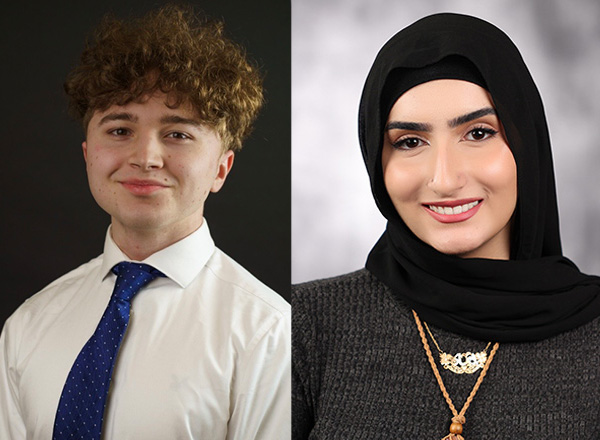
HFC students Easton Anthony Socola and Iman Soubra are the College’s UMSG liaisons.
“I think it’s a great step forward for HFC to be the first community college to join the UMSG, especially for all community colleges around Michigan, because our goal is to take the challenges and conflicts college students face and address them with our leaders,” said Soubra. “The UMSG was solely for public universities until UM-Dearborn invited us to the initial conference with all the members of the student governments. Now we can include community colleges to participate in these conversations.”
Like Fluker and Soubra, Socola is proud that HFC is the first community college to join the UMSG.
“I take a strong sense of pride in that fact,” said Socola. “I would like to thank HFC Student Council Chair Richard Cremeans, UMSG Executive Director Ford Schoonover of Michigan Tech, and UM-Dearborn Student Body President Rupinder Singh for their hard work to include community colleges in this organization. We are honored to be the first community college in the UMSG. We are eager to connect and collaborate with student leaders at community colleges across Michigan, because it can be difficult to find a sense of community. The ability to connect with community colleges statewide is an amazing opportunity to build a stronger sense of connection.”
Addressing issues community colleges face
Socola is the UMSG’s Executive Chair of Community Colleges. He has been tasked with bringing other community colleges into the UMSG.
“I am working to create strong bonds with student leaders across the state to address problems our campuses face collectively and develop solutions together,” he said.
Socola and Soubra want to address issues affecting community colleges. Michigan ranks 37th in the country for post-secondary education with 51.8% of adults holding a certification, according to the Detroit News
“Roughly 1.2 million adults have earned college credits but never completed a credential,” said Socola. “Lowering the age of Michigan Reconnect to 21 (which occurred this summer) gives young adults a better opportunity to put themselves in a better position at an earlier stage of life, aligning with Michigan's Sixty by 30 goal, which aims to have 60% of working-age adults hold a degree or certificate by 2030.”
The second issue they wish to address is transfer credit acceptance at universities.
“Students frequently attend community colleges with the intention to transfer to one of the outstanding universities in our state, but transfer credit acceptance can vary by institution and department,” explained Socola. “Credits that aren't accepted can increase costs and delay the graduation of students pursuing a bachelor's degree. Transfer pathways remain a concern among students and policymakers seeking to increase completion of bachelor's degrees.”
The percentage of Michiganders who hold a bachelor's degree is approximately 34%. Michigan is also ranked 40th in the nation for per-capita income, which has been highlighted by the Detroit Regional Chamber. States with the highest incomes consistently have among the highest rates of bachelor's degree attainment.
"Improving transfer pathways can help more students complete four-year degrees and strengthen Michigan's workforce,” said Socola.
Added Soubra: “This issue directly aligns with concerns surrounding higher education affordability, degree completion, and Michigan's broader economic goals. My involvement in the UMSG is to represent HFC within an organization of Michigan’s public universities coming together to speak about the challenges that college students face, and how we can address these issues collectively and figure out solutions, presenting them to our government for change. We need to take these steps to get there wisely.”
Combining student governments forms a stronger voice for change
A student’s top priority should be focusing on academics, not stressing out about their financial situation, Soubra noted.
“Our leaders can only make an educated guess on what students’ needs are, but by actually hearing and listening to what challenges and conflicts students face, they can provide potential solutions,” she said. “With each generation and improvement of technology, students’ living arrangements financially and socially continue to change. So addressing the target population’s voice and then making an educated guess on what they need would be effective and productive.”
The UMSG reflects a shared goal between students and the state.
“While a single student government can make significant changes, they are often subject to the limits of the university or college. Creating one large body that unites students separates their direct limitations and forms a stronger voice for change,” explained Socola. “Combining student governments unites a larger group to be on the same page and work toward the goals of all students rather than the individual institution. Collaborating with leaders of other student governments creates a group which allows for important feedback, conversations, and brainstorming, all of which are imperative to accomplishing our collective goals.”
He continued: “We'd like to amplify the voice of students, make education as accessible as possible, and see the state that has done so much for me prosper. I would love to see the residents of this state put themselves in a position to succeed. Another goal I'd like to achieve is helping current students realize the power and resources that they have. I encourage students to speak out on issues they recognize, propose solutions to them, and realize their potential in future endeavors.