Apprentices now eligible for college credit leading to expedited degrees
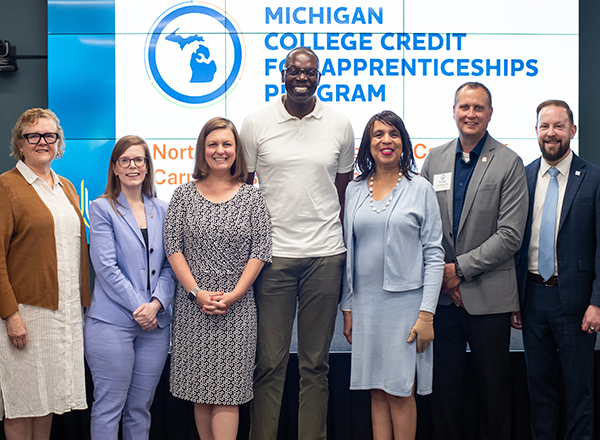
H enry Ford College President David M. Knezek, Jr. joined leaders from the Michigan Department of Labor and Economic Opportunity (LEO), the Michigan Community College Association (MCCA), and the Carpenters and Millwrights on July 16 at a ceremonial signing at the Northern Midwest Regional Council of Carpenters Detroit Training Center. The signing formalized statewide agreements that award college credit to workers who complete Carpenters and Millwrights registered apprenticeship training.
The ceremony marked the second stop in a statewide signing series celebrating the Michigan College Credit for Apprenticeships Program (MI-CCAP), a partnership among LEO; the Michigan Workforce Development Board; the Michigan Department of Lifelong Education, Advancement, and Potential (MiLEAP); MCCA, and the state's skilled building trades unions. First launched in October 2025, the program creates associate degree pathways that recognize the rigorous, hands-on learning apprentices gain through registered apprenticeship training. The program allows them to work toward high-quality college degrees after receiving college credits for their earned expertise.
HFC's DNA started in advancing skilled work
Henry Ford College is among the first community colleges in Michigan to complete the full credit-mapping process for the Carpenters and Millwrights. Using its Industrial Technology General Studies associate in applied science degree, the College evaluated apprenticeship curricula and established course equivalencies that give apprentices a direct, clearly defined pathway to a college credential.
“Henry Ford College was built on the idea that skilled work and higher education belong together. It’s part of our DNA,” said HFC President David M. Knezek, Jr. “For almost 90 years, we have trained the people who build, power, and move this region. The Michigan College Credit for Apprenticeships Program honors what apprentices have already earned and mastered, and gives them an affordable, direct path to a college degree. I can think of no better way to begin my presidency than by signing an agreement to help open doors for Michigan workers and their families.”
Under the agreements celebrated in July, apprentices trained through the Northern Midwest Regional Council of Carpenters registered apprenticeship programs in carpentry, floor laying, and millwright work can receive substantial academic credit toward HFC’s Industrial Technology General Studies degree.
20 credits to earn a degree is possible
HFC has also established equivalencies for additional credentials offered through Michigan Trowel Trades Apprenticeship and Training, including bricklayer, cement mason, pointer cleaner caulker, tile finisher, and tile setter. A person who has successfully completed an apprenticeship in these trades may be able to complete an associate degree at HFC for approximately 20 credit hours.
“Apprentices complete some of the most rigorous hands-on training in the country, and they deserve academic credit for it,” said Dr. Patricia Chatman, HFC Dean of the School of Business, Entrepreneurship, and Professional Development, which houses the College’s Trade and Apprentice Education programs. “Our team evaluated these curricula so that a carpenter, floor layer, or millwright walks through our doors with dozens of credits already in hand. That is real time and real money returned to working people, and it reflects the respect their training deserves.”
Apprenticeship education is foundational to Henry Ford College's identity. Since the mid-20th Century, Trade and Apprentice Education at HFC has grown into one of the largest apprenticeship training programs in the country, built through longstanding partnerships with regional employers and organized labor. MI-CCAP extends that legacy statewide, connecting apprentices across Michigan to degree pathways for hardworking state residents.
Apprentices and employers interested in learning more about apprenticeship degree pathways at Henry Ford College should visit hfcc.edu or contact the School of Business, Entrepreneurship, and Professional Development. Information about MI-CCAP is available at michigan.gov and through the Michigan Transfer Network at mitransfer.org.