HFC launches inaugural Standardized Patient initiative
As the Fall 2025 semester opens, HFC’s Nursing and Theatre programs have collaborated to launch the Standardized Patient (SP) initiative.
A standardized patient is a person hired to portray a patient – often those with specific health concerns or symptoms – in a simulation scenario that provides a realistic and standardized learning experience for healthcare students. SPs serve as a consistent representation of specific clinical conditions. They help students strengthen communication, clinical reasoning, and patient-centered care. Incorporating SPs into simulation programs enriches the realism of scenarios and also prepares healthcare students for the interpersonal and communication demands of clinical practice.
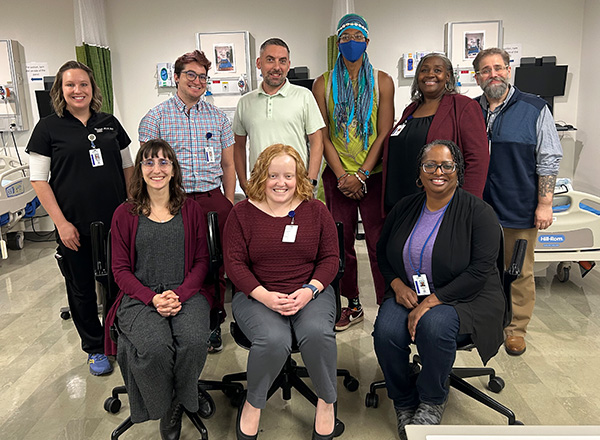
Nine actors recently participated in HFC’s new SP initiative. HFC simulation and experiential learning instructor Elizabeth Martin, a full-time nursing instructor, partnered with HFC Director of Theatre Dr. John-Michael Sefel to create the SP initiative at the College. Daily activities are supported by HFC Lab Associate Gina Gangarossa, with further developmental support from administrations of both the HFC Schools of Liberal Arts (SOLA) and Health and Human Services (HHS).
“John-Michael and I collaborated to design the job description, establish training processes, and integrate SPs into the simulation curriculum,” said Martin. “I continue to play an active role in coordinating, training, and refining the use of SPs within simulation activities, ensuring alignment with curricular objectives.”
History of SPs
The SP program’s beginnings trace back to the University of Southern California in the 1960s. As a formalized, trained, official process, the use of SPs at USC led to further studies and, eventually, to the practice being widely adopted. According to the Association of American Medical Colleges (AAMC), nearly all medical schools in the United States now employ SPs. Educators coach these people on how to portray patients in realistic situations as a means to help medical students learn how to grapple with sensitive issues.
In 1989, the University of Michigan Medical School in Ann Arbor became one of the first medical schools in the U.S. to implement a formal SP program as part of its curriculum. Today, SP programs are standard in healthcare training programs across Michigan, including Central Michigan University, Eastern Michigan University, Grand Valley State University, Michigan State University, Oakland Community College, Oakland University, Wayne State University, Western Michigan University, and the University of Michigan.
“I was first introduced to the concept of SPs while earning my master’s degree in nursing. The benefits of partnering with the campus theatre program were emphasized in order to train SPs, which inspired me to consider this approach for nursing education,” recalled Martin. “After graduating, I made it a professional goal to teach nursing students through simulation-based learning. When I joined HFC, I reached out to John-Michael to explore the possibility of creating an SP program. Together, we spent a year developing a plan to formally establish the use of standardized patients in the nursing program.”
When Martin approached Sefel, his response was an immediate, resounding yes.
“I don't think I've ever written a more enthusiastic email!” recalled Sefel. “So much of my scholarship and work outside of HFC focuses on the crossroads of performance, portrayal, disability, and the medical world. I had been wishing HFC had a program like this, so when Elizabeth emailed me, thinking she would have to sell me on the idea, I’m sure she was probably a bit surprised at receiving such an instantaneous ‘Oh, absolutely yes! We are DOING this!’ response from someone she'd never met.”
Students gain real-world skills, and HFC pursues innovation and excellence
Over the past year, Martin and Sefel spent countless hours working to create the SP initiative, though both emphasized the support they received from Gangarossa, the Human Resources team, and their home departments while working out the complicated details of such a large, interdisciplinary project. Now that it’s up and running, they hope to see it grow into a core part of the College’s offerings.
“As the SP initiative gets going, I suspect we'll end up with more of our students and alumni getting involved. Of the inaugural group, slightly more than half come from theatre backgrounds, but we also have quite a few people with medical backgrounds – including someone currently working as a registered nurse in a trauma bay. It's not ‘acting’ in the way you would think of a play or a movie; it's about accurately portraying certain symptoms and following a carefully constructed scenario to help students become better caregivers. A great actor can bring their skills to the job, but so can someone who has in-depth knowledge of medicine or even someone with strong communication skills, patience, and empathy,” explained Sefel.
The SPs went through a lot of preparation before working with healthcare students. They attended orientations, completed online training, and even did a dry run with faculty, so they knew exactly what to expect. This allows the quality of the nursing program to be protected, according to Sefel, and the SPs feel confident and comfortable.
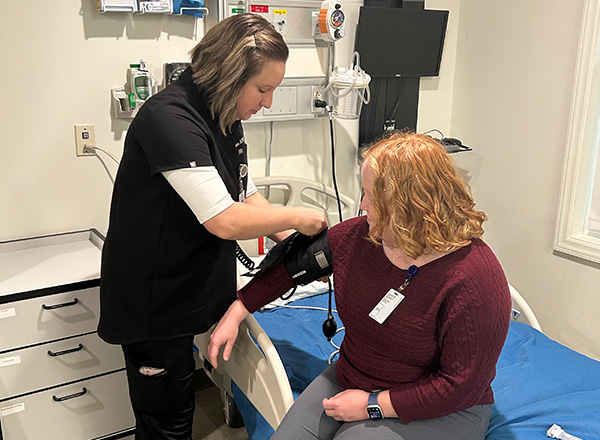
“Even something simple like having a stethoscope on your chest or a blood pressure cuff on your arm can feel intimidating if it’s not handled carefully. Professionalism and consent are always at the heart of the process with faculty present every step of the way,” said Sefel.
He pointed out that although this is a joint project between Nursing and Theatre, Nursing handles the majority of the day-to-day work. Sefel’s role has been finding and preparing the SPs, helping with casting, and guiding them in how to approach their characterizations. Meanwhile, Martin runs the simulations, working directly with the healthcare students and the SPs, and keeping everything moving.
“The SPs get to know both of us, and it’s been a genuinely great partnership. When Nursing and Theatre come together, everyone wins! Our students gain real-world skills, our College furthers its reputation for innovation and excellence, and our community receives the gift of even better-prepared caregivers,” said Sefel. “In one year, which at times felt like forever and other times felt like it flew by far too quickly, we went from Elizabeth's initial query to an exciting, dynamic initiative with an inaugural cohort in place and ready to go!”
For more information about the SP initiative, contact Martin at ekmartin4@hfcc.edu or Sefel at jsefel@hfcc.edu.
Related content: Actors speak about playing Standardized Patients (GVSU video)
In the practice setting: