National Hazing Awareness Week, Sept. 22-26
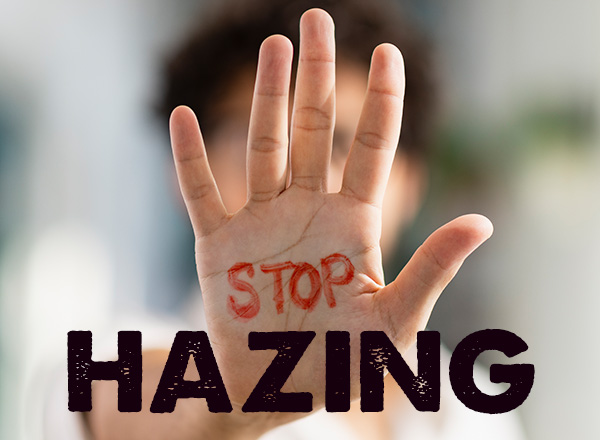
September 22-26 is National Hazing Awareness Week. HFC is committed to supporting the health and well-being of our community, which means eliminating the practice of hazing.
NHAW is an annual initiative that focuses on educating about the dangers of hazing. It is a time when communities, organizations, and individuals come together to talk about hazing and take action against it.
What is hazing?
Hazing refers to any activity that is required for recruitment, admission, affiliation, or continued participation in a group that humiliates, degrades, abuses, or endangers someone, regardless of consent or a person's willingness to participate. Consent to hazing is not a defense.
It is important to realize that hazing and bullying are not the same thing, though they share similarities such as the intent to harm, humiliate, or demean. The key difference is that hazing is done to make someone "earn" their place in a group, while bullying's goal is to exclude and marginalize someone from a group. Hazing is an organized form of bullying. In either case, it is crucial to recognize and address such harmful behaviors effectively.
Stop Hazing Now Act
On December 23, 2024, U.S. President Joe Biden signed into law the Stop Campus Hazing Act. This bipartisan legislation, which amends the Jeanne Clery Campus Safety Act (Clery Act), introduces groundbreaking measures to increase transparency, accountability, and prevention of hazing across higher education in the United States.
The SCHA requires colleges and universities to increase transparency around hazing incidents, implement prevention education programs, and include hazing statistics in their annual Clery reports. The Campus Hazing Transparency Report must be published on the educational institution’s website, and must include:
- Summarize findings regarding any established or recognized student organization found to be in violation of an educational institution’s hazing policy.
- Give a description of the violation.
- Give the name of the organization.
- Give the date of the incident.
- Confirm if drugs or alcohol were involved.
- Provide the findings of the investigation.
- Provide any sanctions placed on the organization.
- Provide the dates the investigation was started, ended, and when notice of outcome was provided to the organization.
The SCHA builds on the Clery Act to address hazing by providing standardized information to the public and promoting a campus culture that prevents hazing. It took effect for HFC on June 23, 2025 and requires the College to include:
- How to report hazing incidents.
- The process used to investigate hazing incidents.
- Information about local or state laws on hazing.
- HFC’s policy regarding hazing prevention and awareness, which requires a research-informed, campus-wide prevention program designed to reach students, faculty, and staff.
HFC resources to prevent hazing and to support our community
Campus Safety provides assistance, safety, and crime prevention services to the community. Call Campus Safety at 313-845-9630 from an outside phone or 9630 from a campus phone (if you call 9911 from a campus phone, the call will go directly to the Dearborn 911 Dispatch Center). Campus Safety can also be reached by email at campussafety@hfcc.edu.
Employee Assistance Program is a free resource that supports the mental health of HFC employees. Here is a list of EAP services provided through Ulliance.
Office of Student Conduct and Title IX: The Title IX Office supports our community in creating and sustaining an environment that is free from all forms of sexual misconduct and discrimination. All members of the HFC community are responsible for understanding and adhering to HFC’s standards of behavior. Contact:
- HFC Title IX Coordinator Munira Kassim at 313-845-6301 or mmkassim@hfcc.edu.
- HFC Employee Deputy Title IX Coordinator Raya York at 313-845-9698 or rdyork@hfcc.edu.
External resources
NOTE: HFC provides links to external resources solely as an informational service to our community. We do not endorse or partner with these external organizations. We cannot provide referrals or any services related to these organizations. We encourage you to ask questions and make sure the support services are right for you.
- National Hazing Hotline: 888-NOT-HAZE or 888-668-4293
- Inside Hazing
- Hazing Prevention Network
- The Recovery Village
- The Gordie Center
- With Us Center
- Mental Health America
- National Alliance for Mental Health Michigan
- Community Mental Health Crisis lines
For questions or more information about National Hazing Awareness Week, contact Campus Safety Manager Karen Schoen at 313-845-9849 or kschoen@hfcc.edu.