Sagenverse delivers “digital twin” online environments
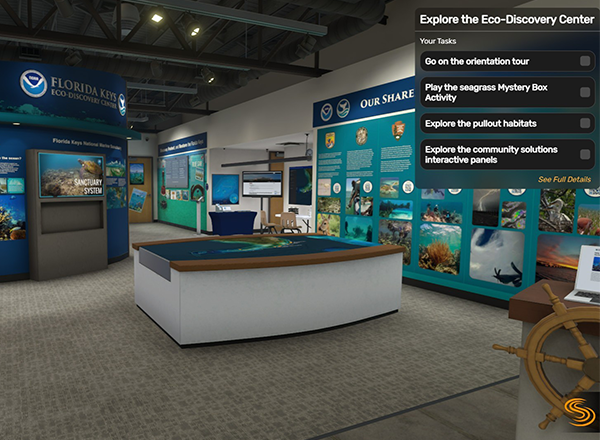
Under the leadership of CEO and HFC alumnus Ben Mazza, Sagenverse enabled the Eco-Discovery Center of the Florida Keys National Marine Sanctuary to extend its outreach exponentially to a global audience by creating a digital twin at no cost to visitors.
"The team at the Florida Keys National Marine Sanctuary wanted to extend the reach of the Eco-Discovery Center beyond its physical location. We worked to build a spatially accurate digital twin that preserves the exhibits and educational materials in an explorable format. The goal was to make the experience accessible to classrooms, remote visitors, and future audiences while maintaining the integrity of the original space," explained Mazza.
Virtual tours are nothing new. Mazza spoke about what makes this one unique.
"Most virtual tours are passive. You look around a space and move on," he explained. "Sagenverse environments are structured. They integrate layered media directly into the environment, allowing visitors to explore content within context. They’re also designed to be maintained and updated over time. That makes them dynamic experiences, not static tours."
Features include:
- A virtual re-creation of the Eco-Discovery Center
- A 360-degree photo tour
- Fully interactive digital maps
- Digital archive of materials and resources
- Links to various shipwreck sites
- Links to an immersive habitat experience with animals in the Florida Keys mangrove area
- Downloadable posters
"Instead of creating a simple interpretation of their collection, we recreated their recently renovated exhibit space as a fully interactive digital twin. It’s something they can regularly update with new materials without needing our help to publish changes," said Mazza. "In addition to recreating the physical center, we built an interactive mangrove habitat that brings visitors directly into the sanctuary areas they are working to protect. We also assembled a digital collection of their maritime heritage artifacts, many of which are normally constrained to protective display cases. The project focused on expanding public access, preserving interpretive content, and creating a structured narrative experience that mirrors the physical environment."
Helping institutions extend educational offerings beyond their geography
From initial planning to capture, modeling, and content integration, the project took several months to complete. Mazza said the technical construction moved efficiently. The majority of the time was spent ensuring accuracy, narrative clarity, and alignment with the institution’s educational goals.
"Sagenverse has given us a unique opportunity to share this extremely important ecosystem with people around the world, including students, educators, adventurers, researchers, and more. We are optimistic that virtual access to our visitor center will inspire even more people to visit and explore the Florida Keys," said NOAA Office of National Marine Sanctuaries Director John Armor.
The greatest challenge of this endeavor was limiting the scope. With such a vast amount of information and content available at the Eco-Discovery Center, it became challenging to fit it all into the digital twin without making it too heavy to run smoothly on devices like Chromebooks.
"We had to be disciplined about what to include and how to optimize it. Ultimately, we found the right balance," said Mazza. "We worked extremely well together with the Eco-Discovery Center’s management and education teams to achieve the experience we were aiming for. I was particularly encouraged by how the technology inspired them to think creatively about how they tell their story and connect with their audience."
He continued: "I’m also thrilled to see that an institution like this can now extend beyond its geography. The digital twin enables students and visitors who may never travel to the Florida Keys to experience the exhibit in a meaningful way. Expanding access to public science education is incredibly rewarding."
Expanding partnerships with organizations wanting long-term digital continuity
An alumnus of Dearborn High School, Mazza attended HFC, where he studied general education, art foundations, and media production. He then transferred to the Illinois Institute of Art–Chicago, where he earned his bachelor’s degree in media arts and animation. He also earned a certification from Stanford University's computer science online program, focusing on human/machine interactions (HMI).
Mazza has worked for Sagenverse, which is based in Ann Arbor, since 2019 when it was initially called Saganworks. The company changed its name in 2024.
"We evolved from Saganworks to Sagenverse because the company matured," he said. "Originally, the name described a spatial knowledge room. Over time, the platform expanded beyond that single concept. We’re now building a broader publishing system for institutions."
The new acronym SAGEN stands for "Spatial Archives and Galleries for Engaging Narratives." It reflects preservation, structured storytelling, and long-term access. The new name better represents the scale and seriousness of what they’re building. A SAGEN enables individuals and organizations to organize information spatially instead of relying on folders or static web pages. It supports video, audio, documents, imagery, 3-D models, and interactive media within a structured 3-D environment. For individuals, that might mean family archives or portfolios. For institutions, it becomes a publishing framework for exhibits, research, training, and public education.
In late 2025, Mazza became the CEO of Sagenverse.
"I’ve been with the company for more than six years and have had the opportunity to work on nearly every aspect of the platform. I’m excited to leverage that experience into the decisions that shape the future of the organization," he said. "We’re continuing to expand partnerships with museums, universities, and public institutions that want long-term digital continuity. We’re also expanding our free online museum project, the Chronosphere, with new exhibits. Our next one will focus on the British Museum’s Hall of Enlightenment."
Sagenverse’s focus is on making more collections spatially accessible. Museums, research institutions, and public organizations hold extraordinary knowledge, but much of it is limited by geography or traditional web formats.
"We’re working to help institutions transform those collections into structured, explorable environments that can be experienced anywhere," said Mazza. "The goal is simple: Expand access, preserve context, and make important knowledge easier to engage with for the next generation."