Register to vote in the August Primary Election
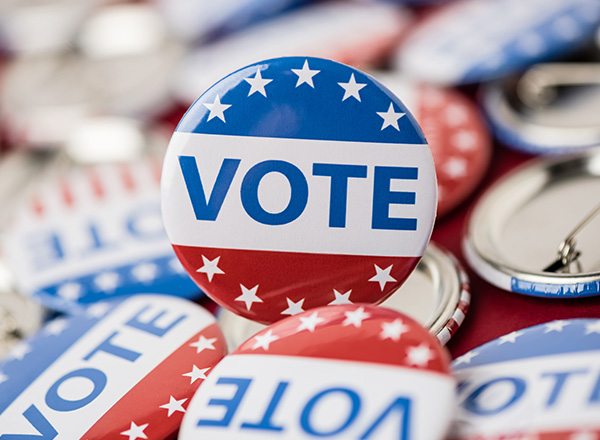
Summer brings a great chance to participate in our democracy. The statewide Primary Election takes place on Tuesday, August 4.
You still have plenty of time to register to vote, research the candidates and the issues on your ballot, and vote.
What are the primaries and why should I participate?
The Primaries are important because they determine which candidates will advance to the General Election ballot for the Midterm Election. This year’s Midterms will be on Tuesday, November 3.
Midterms are the national elections held at the halfway point of the President of the United States’ four-year term of office. During Midterms, you can vote for candidates for:
- The U.S. House of Representatives
- The U.S. Senate
- The Secretary of State of Michigan
- The Governor of Michigan
Other local positions will be up for election, such as county officials, city council members, school board members, and judicial election candidates, depending on where you live. Find out what is on your individual ballot here.
The primary election provides you with the opportunity to encourage the future direction of political parties, and help shape a party's platform. Based on voter turnout and primary results, parties rework election strategies and devote attention and resources toward certain demographics, states, and issues.
Voting eligibility requirements
To vote in the state of Michigan, you must be:
- A citizen of the United States of America.
- A resident of Michigan and the city/township where you are applying to register to vote for at least 30 days prior to Election Day.
- At least 18 years old by Election Day.
- Not serving a felony sentence.
If you’re not sure whether you are registered to vote or want to check your polling place, visit the Michigan Voter Information Center. Your local clerk can also answer any questions about voter registration, polling place location(s), and working at the polls (a paid role) on Election Day.
Helpful tips for voting
- Check your registration and find your polling place at Michigan.gov/Vote.
- If your registration is not up to date, you can update your registration online if you have a valid Michigan driver’s license or state ID. Otherwise, you can bring an alternative proof of residency (accepted documents are listed here in person to your local city clerk’s office to update your registration.
- Bring photo identification showing your current address with you to the polls. If you do not have photo ID, you can still vote. You will need to sign an affidavit before voting. You can request this form when you go to the polls.
- Request use of the Voter Assist Terminal if you have a disability or would prefer to use it.
- Maintain the secrecy of your ballot. Keep your ballot in its secrecy sleeve, except when voting, and then up until the time you feed it into the tabulation machine.
- Do not speak to anyone who says they are a poll watcher or challenger. These individuals are not allowed to speak to voters. They must maintain their distance and not interfere with voting. Report violations to an election worker immediately.
- Do not leave the polling place without voting. The law requires that anyone who is in line by 8:00 p.m. on Election Day must be allowed to vote.
- Do not allow anyone else to cast your ballot for you or show it to anyone. You must personally place your private ballot into the tabulation machine.
- Report any voter intimidation, harassment, or coercion that you see. Notify an election worker or contact the nonpartisan election protection hotline at 866-OUR-VOTE.
Absentee voting in Michigan
All registered voters in Michigan have the right to vote by mail using an absentee ballot delivered to their home. Voters can also request an absentee ballot directly from their local clerk’s office. Absentee ballots are available beginning 40 days prior to every election, including the Primaries.
Michigan voters can now join the permanent absentee ballot list by checking a box on the application to automatically receive an absentee ballot for every election.
Learn more about absentee voting:
- Requesting an absentee ballot
- Completing and returning an absentee ballot
- Absentee voting security
- More voting options and information
Other important dates
Please make note of these important dates:
- July 25-August 2: Early voting period.
- Monday, July 20: Last day to register to vote by mail or online for the primaries (Note: Same day registration is available in person at your voting location on August 4).
- July 21-August 4: To register, new voters are required to apply in person at your local clerk’s office for the primaries.
On August 4, Primary Election Day, polls will be open from 7:00 a.m. to 8:00 p.m. Find your polling place here.
Make sure your voice is heard and vote!
What is on the ballot in Michigan?
The following are up for election this year.
At the federal level:
- U.S. Senator: The U.S. Senate is one of two chambers of the federal legislature. Senators are responsible for writing and passing legislation, approving presidential appointments, and ratifying treaties with foreign countries.
- U.S. Representative: The U.S. House of Representatives is one of two chambers of the federal legislature. Representatives begin the legislation process, offer amendments, and serve on committees.
At the state level:
- Michigan Governor: The Governor is the chief executive officer of a state and responsible for implementing state laws and overseeing the operation of the state executive branch. The Governor oversees legislative proposals and votes, executive budgets, and implements executive orders.
- Michigan Secretary of State: The Secretary of State oversees elections and administers motor vehicle services. As the state's chief elections officer, the Secretary of State manages voter registration, maintains the statewide voter file, and certifies election results. As a motor vehicle administrator, the Secretary of State issues driver's licenses, state IDs, vehicle registrations, and titles.
- State Senator: State Senators are members of the state’s upper chamber and are responsible for voting on bills for public policy matters, levels for state spending, raises or decreases in taxes, and whether to uphold or override gubernatorial vetoes
- Michigan State Representative: State Representatives are members of the state’s lower chamber and are responsible for voting on bills pertaining to public policy matters, levels for state spending, raises or decreases in taxes, and whether to uphold or override gubernatorial vetoes
More information
For more individualized voting information, visit Michigan.gov/Vote.
Follow-up questions about the voting process or need additional resources? Contact Student Activities at 313-845-9865 or studentactivities@hfcc.edu.
Henry Ford College and the Office of Student Activities are committed to providing non-partisan voter information to all students, regardless of political affiliation. HFC does not endorse candidates or political parties.