Dennis Ringle stresses history’s importance for America’s 250th birthday
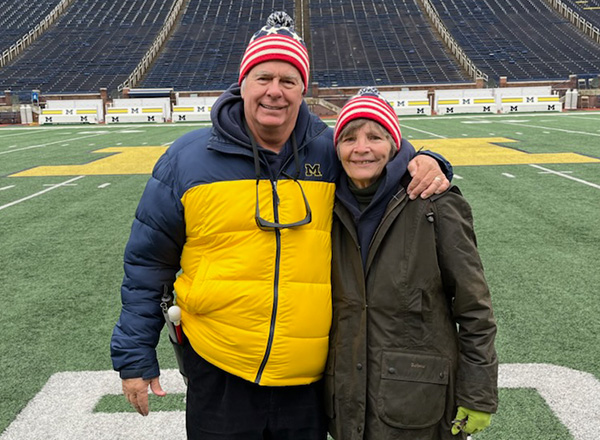
As the United States celebrates its 250th anniversary, retired HFC history instructor, author, and retired Naval officer Dennis J. Ringle reiterated the importance of studying history.
“There’s the saying, ‘Those who do not learn from history are doomed to repeat it,’” said Ringle. “History is important because it gives you a basis for everything. Even business majors can see the economic ups and downs of history. And the medical community has gained enormous knowledge from so many wars throughout history.”
He continued: “True, things are very polarized today, but we’ve had worse times. Things were worse in the 1960s with the murders of John F. Kennedy, Robert F. Kennedy, and Martin Luther King, Jr. There was also Vietnam, which was a very divisive time in our nation’s history. History is important to see where our country’s been and where it’s going. We need to think about everything we’ve endured. There’s something to be said about our democracy and our Constitution.”
22-year Navy veteran, a family tradition
Born in Detroit, Ringle is the youngest of two. He lives with his wife Donna in Newport. He was a member of the final class of St. Ambrose High School in Detroit, graduating in 1972. He earned his bachelor’s degree in biology from Wayne State University, where he was active on the crew team, attending on an athletic scholarship. He earned his master’s degree in history from Eastern Michigan University and his MBA from Central Michigan University. The GI Bill paid for his education at EMU and CMU.
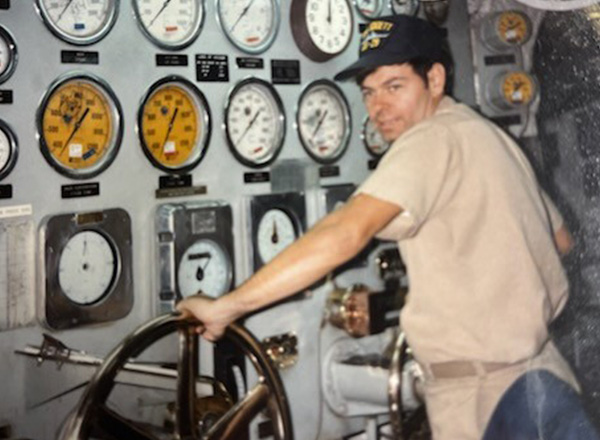
From early childhood, Ringle wanted to be in the U.S. Navy, a tradition in his family. Ringle served for 22 years, rising to the rank of commander before earning an honorable discharge and retiring from military service in 1997.
“My dad was in the Navy during World War II. He was stationed at Guadalcanal in the Solomon Islands. I had three uncles who were also in the military. They were all stationed in Pacific. I had two cousins who were career Navy as well,” explained Ringle.
During his time in the Navy, Ringle served aboard five ships. He was in the engineering department of four ships. He noted that the Navy awards equivalent degrees for time served in certain areas, so he earned the equivalency of a bachelor's degree in mechanical engineering in 1987.
Enjoyed teaching at the Naval Academy, U-M, and HFC
While at Wayne State, Ringle applied for Officer Candidate School in Newport, RI, but got a delayed entry. He eventually attended, earning a commission as an ensign.
For nearly 10 years, Ringle taught Naval Junior Reserve Officers' Training Corps at Monroe High School. He was also a Naval Reserve Officers’ Training Corps (ROTC) instructor at the University of Michigan in Ann Arbor for five years. He even taught at the U.S. Naval Academy in Annapolis, MD for three years.
“Teaching JROTC at Monroe opened up another door for me. During the summers, we would go to Rhode Island, where I’d teach sailing to students for two weeks. I did that for 20 years, and it didn’t get any better than that,” he recalled. “Looking back, I wasn’t good enough to be a student at the Naval Academy, but I was good enough to be a teacher there. I always laugh about that.”
Ringle taught at HFC (then Henry Ford Community College) for six years before retiring.
“I had a great time teaching at HFC,” he recalled. “The students were great. I seldom stood behind the podium. I’d walk around the classroom and challenge my students randomly. I would put them in role-playing positions – ‘You’re Abraham Lincoln. What would you do in this situation?’ I did this to make them think. I tried to bring realism into the classroom as much as I could.”
Book he authored served as a staple foundational text for the Navy
Ringle always wanted to write a book. In 1998, he penned Life in Mr. Lincoln’s Navy. This nonfiction book chronicled life in the Union Navy during the Civil War, from recruiting, clothing, training, shipboard routine, entertainment, and wages to diet, health, and combat experience. It also takes a look at 19th-century social history, including issues like racial integration in the military and the enlisted sailor's enormous contributions to the development of the Navy as it moved from wood and sail to iron and steam.
Published by the Naval Institute Press, Life in Mr. Lincoln’s Navy was once part of the Navy’s Professional Reading Program. For more than 15 years, Ringle spoke about the book around the world, including in Europe and at the Naval Academy.
“The focus wasn’t so much on the admirals, generals, and the battles, but the people who made up the service,” he said. “There aren’t very many books about the common soldier. I’ve presented papers and lectures about this over the years.”
HFC history instructor and department chair Dr. Hal M. Friedman called Ringle one of the College’s best history teachers ever.
“Dennis was extraordinarily skilled at reaching out to our student body, perhaps because he led largely enlisted sailors in their late teens and early 20s, then commanded Monroe’s Naval JROTC for 10 years where he had an entirely teenage student body,” said Friedman.
In addition to his teaching, Ringle stood out because of his scholarship, noted Friedman.
“I had to get a Ph.D. to learn how to write a history book. Dennis did it with a master's degree and is one of the very few people I know of in the profession who could do that,” said Friedman. “He wrote his master’s thesis at EMU on the life of common sailors in the Union Navy during the Civil War, a subject that had not been written about extensively. Not only was the study successful as a thesis, but he wrote it part-time while he was the Executive Officer of Naval ROTC at U-M. In addition, the thesis became a published monograph with the Naval Institute Press and was on the Chief of Naval Operations' Professional Reading List for 15 years, serving as a staple foundational text.”