Caring Campus initiative amplifies student belonging
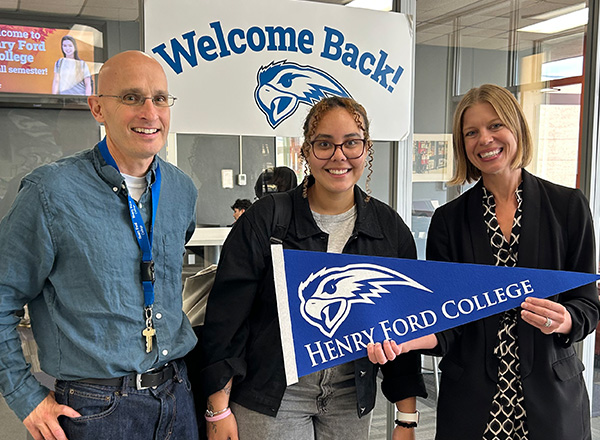
By the end of 2026, HFC will implement the Caring Campus Initiative, which was created by the Institute for Evidence-Based Change (IEBC) as an effort to enhance students' experiences and sense of belonging, and their overall success.
Students come to places where they feel welcome, and they stay where they feel valued. Thousands of students already feel this way at HFC, but there is always room for improvement. It is important for HFC to evaluate the services we offer, how well students can access and benefit from these services, and how well they are treated across the full spectrum of their time at the College.
Caring Campus is based on research that demonstrates students who feel more connected to their college are more likely to stay from semester to semester and complete their academic goals, including graduation. Increasing belonging, therefore, can go a long way toward increasing the likelihood of maintaining enrollment.
“Are we speaking with one voice? Are we living up to our promise of being a welcoming college?” said HFC Interim President Dr. Lori Gonko. “We’ve been focusing so much effort on student success these last few years, and we’ve made excellent progress. Our hope is that Caring Campus helps tie our efforts together and takes student success to the next level.”
What is Caring Campus?
More than 100 colleges across the United States are implementing Caring Campus, and they are seeing improvements in student satisfaction and success. Achievement gaps are being closed.
Caring Campus starts with behavioral commitments by college employees. Behavioral change among a large group of people leads to culture change.
Caring Campus:
- Encourages behavioral changes that improve and enhance student-focused efforts that are already being implemented. Behavioral change leads to culture change.
- Is an intentional effort to make students feel welcome and create a sense of belonging.
- Engages staff who are sometimes less visible in student success efforts, such as administrators and other non-faculty members.
- Helps staff connect with one another and with other employee groups to sustain a positive college environment.
- Reexamines policy barriers to student success.
“The Caring Campus work is not another initiative. It just brings the human component in to support all other initiatives and each other,” said Caring Campus Coach Dr. Donna Jovanovich of IEBC.
HFC’s Caring Campus Core Team
HFC’s Caring Campus Core Team comprises 31 dedicated team members who will create ideas, develop proposals, and implement a plan tailored to HFC’s approach to Caring Campus.
The Caring Campus Core Team is actively working to develop thoughtful, practical ideas for how the College will implement and strengthen the five Caring Campus Behavioral Commitments. This process involves reflecting on current practices, identifying areas where HFC can grow, and designing strategies that make these commitments visible and consistent across daily interactions.
HFC Admissions Recruiter Angie Church is a member of the Caring Campus Core Team.
"When I joined HFC as a new employee, I felt welcomed and supported from day one,” she said. “I realized very quickly that HFC is a place where people care about each other and model kindness. I was inspired by the warmth that I felt at HFC, and that drew me to learn more about Caring Campus. This exploration is an opportunity to be thinking about ways for us as a College to deepen our commitment to welcoming and supporting students, as well as nurturing our relationships with colleagues. Caring Campus can be a vehicle for us to broaden and strengthen the welcoming spirit that already lives throughout the campus."
Five Behavioral Commitments
The entire campus community will work together to provide the consistency and experience of Caring Campus. This includes five behavioral commitments:
- Ten-foot rule
- Wear name tags
- Cross-departmental awareness
- Warm referrals
- Welcoming students
1. Ten-root rule
Being seen and acknowledged is important for students. The ten-foot rule supports welcoming and access.
Whenever a student is within 10 feet of an employee, the employee should openly acknowledge them with a greeting, a smile, and friendly demeanor. If the student needs assistance, the employee should provide it or make a warm referral (see below).
In a virtual environment, efforts can include:
- Reach out to students via phone, email, and text.
- Actively communicate important dates.
- Let students know we are available to answer questions, address their concerns, et al.
“The Ten-Foot Rule can significantly influence a student’s decision to continue their studies at the College. When an employee notices a student who appears uncertain or in need of direction, they should take the initiative to approach, greet, and assist them to the fullest extent possible,” said HFC Assistant Director of Enrollment Services, Assessment, and Orientation Nikole Ford-Kondraciuk, who is the Caring Campus Liaison.
2. Wear name tags
Employees should name badges or lanyards with their names visible.
- This is an invitation to friendliness.
- It personalizes and humanizes people.
- It reduces psychological distance.
- Students know whom to approach if they have questions.
In a virtual environment, efforts can include:
- Starting each contact with the employee's name and department.
- Making sure the employee has the student's names and contact information in case they get disconnected.
- Employees' email should end in a standard signature (name, title, phone number, email address).
3. Cross-Departmental Awareness
When employees do not know what other departments on our campus do, it can be difficult to make the right referral for students when they are asking for help. One way to alleviate this is to keep the employee directory updated with more than just a name and department.
Employees will make a commitment to:
- Learn about other departments, so they know where to send students.
- Maintain accurate and updated directory information.
- Implement a frequent review process.
4. Warm Referrals
If you are an employee and a student approaches you for help, it's OK if you do not know the answer. You can warmly refer them to someone who does.
- Walk the student to wherever they need to go (if possible).
- Call ahead to ensure someone is present to assist the student.
- Follow up to ensure the student’s question(s) were answered or their needs were met.
In a virtual environment, efforts can include:
- Obtaining the student’s contact information, so the employee can provide it when they make a referral.
- Making the connection on the student’s behalf by calling the receiving party.
- Leveraging technology like Teams chat to see who is available to help.
- Copying the student on the emails pertaining to their situation with the parties who are directly involved (being sure to respect privacy regulations).
Making these efforts will eliminate cold transfers (passing off the student without talking to the receiving party). It will also eliminate the student from repeating their story again and again.
5. Welcoming Students
One size does not fit all. We should look for any opportunity to welcome students.
Some efforts might include:
- Setting up information tables the first week of the term.
- Meeting students in the parking lots and guiding them where they need to go.
- Welcoming students at all term start dates (15-week, 12-week, 8-week).
- Sending a virtual greeting the first week to welcome students.
“Every interaction is an opportunity to create a positive and lasting impression,” said Ford-Kondraciuk. “When we consistently make students feel welcomed and supported, we help foster the sense of connection that is critical to their success and persistence.”
For more information about Caring Campus, contact Ford-Kondraciuk at nkford@hfcc.edu.