HFC welcomes Dr. Casey Andrews, who brings his love of chemistry to the classroom
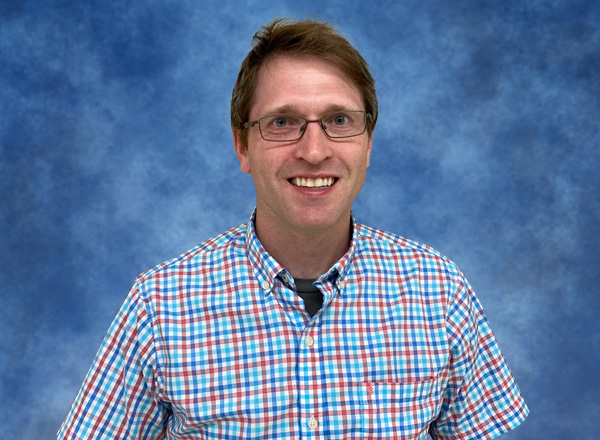
From a young age, Dr. Casey Andrews has always been interested in performing experiments, so choosing a career in chemistry was no surprise.
“My mom always tells the story of how, as a kid, I would mix various ingredients together and expect my family to eat the results,” recalled Andrews, laughing. “I've always been curious on how and why things work. I really decided to pursue chemistry when I was in high school. Performing lab experiments during chemistry class was easily the most interesting and the most fun I had in class during high school. The time would just fly by. Also, understanding how the atom works and behaves during lecture was incredibly interesting to me. A shout-out to my former chemistry teacher, Lauren Thompson, for running such a great class!”
The Fall 2025 semester marks Andrews’ first at HFC. This semester, Andrews is teaching Principles of Chemistry lab and Principles of General and Inorganic Chemistry. His supervisor is HFC Chemistry Faculty Chair Dr. Paul Root.
“I'm really glad to be here,” said Andrews. “The focus on teaching and providing the best classroom experience possible is what led me to HFC.”
Teaching was more fulfilling than his own scientific discoveries
The youngest of four sons, Andrews was born in Spring Lake. He lives in Dearborn with his wife, Jacqueline Shay.
Andrews is an alumnus of Spring Lake High School. He earned his bachelor’s degree in chemistry from Grand Valley State University and his doctoral degree in biochemistry from the University of Iowa.
“My interest in teaching really came from my graduate work,” explained Andrews. “As a senior graduate student, it became my role to train and teach all of the new undergraduates and graduate students who would join our lab. Teaching them and watching them succeed was much more fulfilling to me than my own scientific discoveries, and from then on I knew I wanted to be an educator.”
Depth and versatility for HFC’s chemistry program
Andrews has been teaching since 2016, when he taught experimental biochemistry at Iowa. In 2017, he taught general chemistry, biochemistry, and physical biochemistry at Coastal Carolina University. From 2018-25, he taught general chemistry and biochemistry at Texas A&M University-San Antonio before getting hired at HFC.
“The main reason I decided to come to HFC is the dedication to teaching," said Andrews. "In all my previous positions, publishing research papers and receiving research grants have seemed to be a higher priority at the university. To come to an institution where all of my colleagues are as dedicated to teaching as I am felt right. Second, I am a Michigander at heart and after being away since 2010, it is nice to be back home.” He added tongue-in-cheek: “Although, I haven't seen snow in seven years, so we will see how strong my love for Michigan is during the winter!”
Dean Janice Gilliland of the HFC School of Science, Technology, Engineering, and Mathematics (STEM) is glad Andrews has joined the HFC faculty.
“We are delighted to welcome Dr. Andrews back to Michigan after nine years of teaching at three different universities,” said Gilliland. “With extensive experience across multiple levels of chemistry, he brings both depth and versatility to our program. His enthusiasm for helping shape the transformation of Principles of Chemistrey – with the addition of recitation and innovative lab assignments – will create engaging learning opportunities for our students and strengthen our chemistry curriculum.”
Community colleges give people the tools and training needed to better themselves
Andrews gave his insights on the role of a community college.
“To me, a community college is really meant to uplift the members of the community,” he said. “Not everyone has the time or money to go directly to a big university right away. A community college gives people a good start and allows them to stay with their families while receiving a great education that is affordable. We are giving people the tools and training they need to better themselves, which ultimately betters us too.”
Andrews spoke about his love for teaching chemistry.
“The best part of chemistry is being able to explain why pretty much any natural occurrence in the world happens. Why does water boil at 100 degrees Celsius? Chemistry can explain that. Why do oil and water not mix? You learn about that in chemistry. Why can a medicine like Advil reduce headaches? That can be explained through chemistry.”
The best part of his job is the students, especially those who struggle with chemistry and gut it out, earning a decent grade in the end.
“Seeing my students go off to successful careers or further their education after taking my courses always makes me proud of them,” he said. “It is really satisfying to help lift people up to their potential.”