Get to Know HFC: Steve Murrell was heavily influenced by his NASA-employed dad
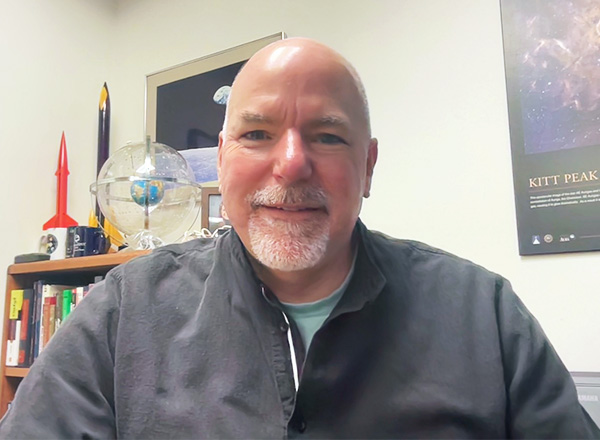
HFC physics and astronomy instructor Steve Murrell’s father worked on the Gemini and Apollo programs for NASA, which were among the earliest manned space-exploration efforts from the mid-1960s to early 1970s. Those heady days of the space race had a massive impact on the younger Murrell's career path.
“My father was a physicist who worked on the development of fuel-cell technology. Fuel cells provided the power to the Gemini and Apollo spacecraft,” recalled Murrell. “I was heavily influenced by my father’s work, especially when he let me accompany him on some of his weekend visits to the NASA campus.”
Seventeen years in industry before switching to higher ed
The fifth of six children, Murrell was born in Houston, TX. His family moved to Michigan when he was 8. He lives in Saline with his wife of 39 years. They have two children and five grandchildren. His hobbies include playing the piano, the bass guitar, and an instrument called the Chapman Stick.
Murrell graduated from Saline High School. He is a two-time alumnus of Eastern Michigan University, where he earned both his bachelor’s and master’s degrees in physics. He also completed graduate coursework at Wayne State University.
Murrell spent 17 years in industry before going into higher education. He began his career right out of undergrad at KMS Fusion, Inc. in Ann Arbor, where he designed and built diagnostic systems for imaging laser-induced plasma produced by inertial confinement fusion reactions. This was also the topic of his master’s thesis.
After five years at KMS, Murrell worked at the Environmental Research Institute of Michigan (ERIM) in Ann Arbor. There, he developed computer simulations of airborne synthetic aperture radar systems. He then spent five years at Ford Motor Company Scientific Research Labs, working as a physicist. While there, he helped develop a new technology called thermo-acoustics. His final five years in industry were spent at General Dynamics in Ypsilanti, developing and operating airborne radar and optical imaging systems.
This was when his teaching began. “For four years, I continued to work as a physicist full-time while teaching part-time,” he said.
Physics dads
Murrell’s teaching began in a surprising way. He was attending a program with his elementary-school daughter. He happened to be sitting by now-retired HFC physics and astronomy instructor Michael LoPresto, whose daughter was also a participant. They introduced themselves and started talking. When LoPresto learned Murrell was a physicist, he extended an offer for him to teach at HFC.
“I’ve always been interested in higher education, but I just didn’t realize it until I began to teach,” he explained.
Murrell has been teaching since 1999. For four years, he was an adjunct faculty member at both HFC (then Henry Ford Community College) and the University of Michigan-Dearborn. He has been a full-time faculty member at HFC since 2004.
An absolutely refreshing approach to teaching
In 2025, Murrell became the faculty chair of the newly named Physics, Astronomy, and Earth Science Department. This new department emerged from what used to be the Physical Science Department. The other half of that department is now Chemistry.
“The most challenging aspect of my job at HFC has been learning all the details and requirements of being a faculty department chair,” said Murrell. “Of course, the studets are my favorite part of teaching. The student population here is so diverse, and I have always found them to be cordial, mature, attentive, and tenacious.”
HFC physics and astronomy instructor Jesse Mason couldn’t have asked for a better teaching mentor than Murrell.
“Steve has been generous with his time and talents, and his approach to teaching is absolutely refreshing – dovetailing peer instruction techniques with active discussion and hands-on activities, and always leading the class toward the highest impact learning experiences,” said Mason. “He’s such an inspiration!”