Get to Know HFC: Rosic brings artistic talents to the classroom
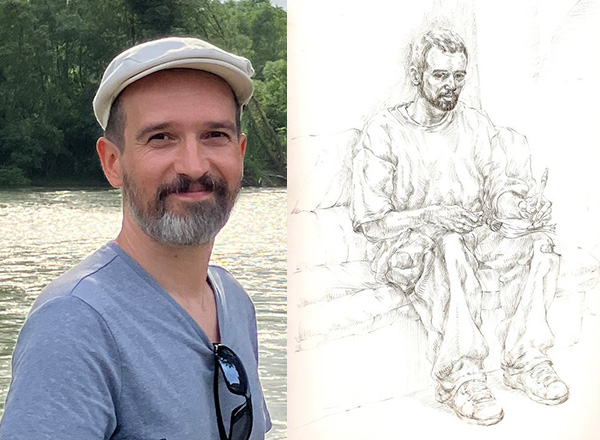
Teaching is a way for HFC fine arts instructor Nemanja Rosic to give back to the community and make an immediate and lasting impact on students.
“I was very lucky to have some incredible teachers and mentors who helped me tremendously in shaping my future,” said Rosic. “They impressed me with their integrity and care for their profession and students, becoming my role models. This might also be coupled with some vocational affinity I inherited: Both my mom and my aunt are university professors.”
A good team player
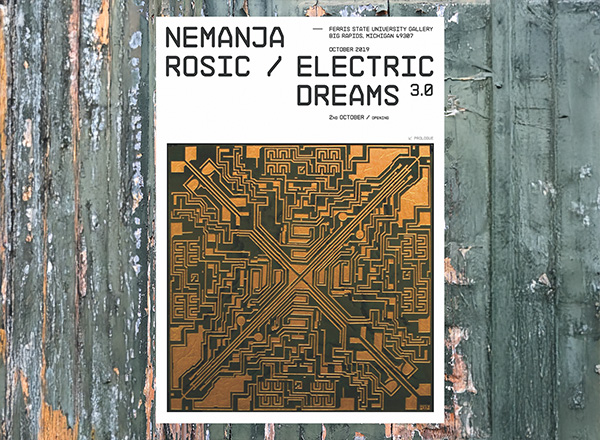
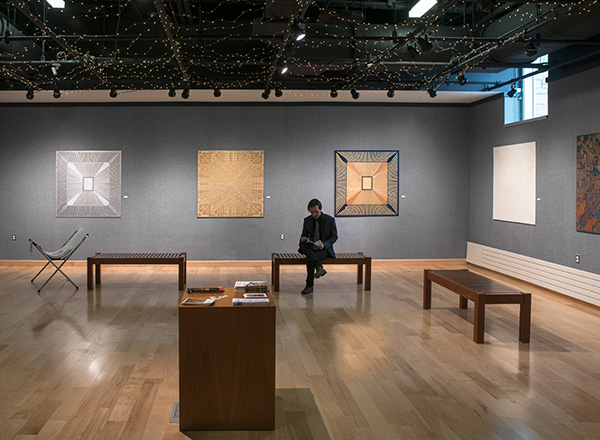
Rosic has been teaching since 2002 and creating art for much longer. His artwork has been featured in exhibitions throughout his career, including at HFC.
“In my mind, Nemanja fits in very well at HFC because he believes that you need to know how to master the basics, the foundations of art, before stepping out and exploring the latest fad. I value and trust his input when I have a question for him; he’s a good team player,” said HFC fine arts instructor Steve Glazer.
The eldest of two sons, Rosic was born in Belgrade, Serbia (formerly Yugoslavia). Rosic immigrated to the United States in the 1990s and lives in Washtenaw County. He is fluent in English and Serbian, and conversational in French and German.
Rosic completed high school overseas. He attended Macomb Community College and transferred to the University of Michigan in Ann Arbor, where he earned his bachelor’s degree in drawing and painting. He later earned his master’s degree in painting from Eastern Michigan University. While at U-M, Rosic completed a study abroad program in Florence, Italy. There, he studied art, art history, and the architecture of Florence during the Renaissance.
1980s pop culture sparked his creativity
Rosic spoke about what inspired him to become an artist.
“My generation was heavily influenced by 1980s sci-fi movies, video games, and MTV,” explained Rosic. “The appeal of the pixelated graphics and geometric virtual spaces of early vector-based animation, such as the video for Dire Straits’ ‘Money for Nothing,’ along with books like William Gibson’s Neuromancer or flicks like Blade Runner, Tron, War Games, E.T. the Extra-Terrestrial, and the original Battlestar Galactica TV series shaped my adolescence. To an extent, they were catalysts for my infatuation with flickering visions of futuristic mega-cityscapes and ornate switch-filled interiors and exteriors of spaceships, spacesuits, alien robots with human traits, ‘living computers,’ and robotic exoskeletons worn by space-explorers. I kept doodling stuff like that in my notebooks, which allowed me to mentally wander into the ‘outer limits’ beyond the gleaming TV screen, somewhere in my iteration of the ‘future world.’”
His parents weren’t thrilled when he told them what he wanted to do for a living.
“Our world at the time was falling apart with the country (Serbia) being in the midst of a civil war,” he said. “There was no room to think about things other than making ends meet, so all else had to be put on hold until we got our chance to emigrate to the U.S.”
Artistic influences and process
His influences on his artistry are as numerous as they are eclectic, particularly artists who explore their relationship to science or scientific creation through artistic practice:
- Leonardo da Vinci, particularly his sketchbooks
- Rembrandt, particularly his painting “The Anatomy Lesson of Dr. Nicolaes Tulp”
- Peter Halley, particularly his circuit-like paintings, which were central to the Neo-Conceptualist movement of the 1980s
- Piet Mondrian, who is famous for pioneering abstract art and devising the painting technique called Neoplasticism
- Georges Seurat, who devised the painting technique called Pointillism
- James Siena, whose pattern-based artwork is referred to as visual algorithms
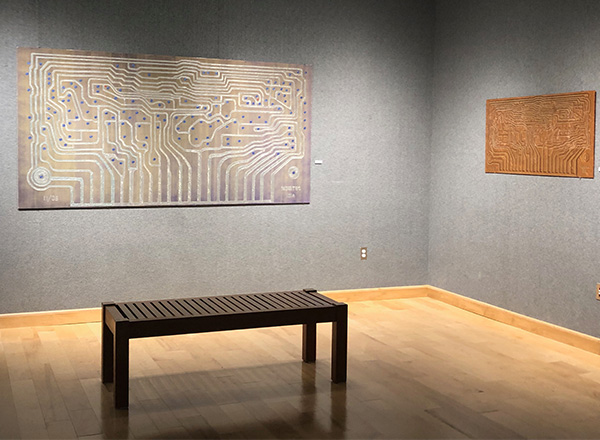
“I feel a need to pay homage to scientific creation of a particular kind with the work I do. By painting the microchip, I get closer to demystifying this incredible technical device,” he explained. “I need to explore and become more familiar with the structures and possibilities of technological devices. I tend to be mystified by the complex, compact design of a computer processor. By dissecting and re-assembling the chip – the core of a computer’s brain – via painting, I seek to understand its potential through visual analysis and exhibit the visual consistency, unity, symmetry, and texture I find in the circuitry.”
Rosic continued: “My paintings portray the micro-circuit: Its physicality and, to me, an appealing pictorial strength. Similar to Halley’s abstract experiments, Siena’s pattern-based paintings, or Mondrian’s design-oriented work, I strive to turn these portraits into beautiful and visually powerful macro-objects. I seek to assign greater significance to a chip beyond just its functionality and use my artistic practice to marvel at the importance of science for contemporary society.”
Rosic paints on aluminum or plexiglass with transparent acrylic paint. He uses the acrylic medium mixed with pigments to cover the chosen surface with a thick, transparent glaze that mimics factory-based silicon layering. Similar to the factory printing process, Rosic transfers the design onto the acrylic glaze film, exposing the sections and channels. The channels have a networked appearance, resembling the micro-wires of the chip circuitry. After these sections and channels have been colored, the work becomes a large painted image of the miniature conductors of the circuit.
“Like all of HFC’s studio art faculty, Nemanja is a practicing artist,” said Glazer. “His own paintings have a quite fascinating theme behind them.”
HFC is fertile ground for experimentation
Rosic has taught at HFC since 2011. He reports to Faculty Chair of Fine and Performing Arts Vicki Shepherd. He also teaches at Washtenaw Community College. Previously, he taught at EMU.
“HFC is a place with a diverse student population that offers a rich mix of cultural heritage and learning styles,” said Rosic. “Students form a veritable think tank in the classroom, always providing a variety of different perspectives on any given issue. This is very important to me because it is paramount in art to have a unique mode of expression, and this variety certainly helps students think about and discover their own. HFC is also fertile ground for experimentation and finding innovative ways to answer student questions.”
He continued: “HFC faculty seem very engaged with and interested in the success of their students and collegial projects. At HFC, everyone has a voice to be discovered and nurtured, but common goals direct individual visions. I feel I can relate and contribute to the student and faculty body. I feel quite welcome and can be there for my students, meeting them where they are and helping them go where they want to be.”
For Rosic, the best part of teaching is witnessing his students’ success. Recently, Malak Cherri became the first HFC student to win the prestigious Kresge Artist Fellowship Award. Cherri called Rosic an inspiration.
“As a student who took many classes with Professor Rosic, I can attest that he is the most considerate, encouraging, and caring professor I’ve come across,” said Cherri. “He’s shown wonderful capabilities, has a great eye for detail, and is very focused on the success of his students. HFC should be proud to have a great professor like him.”